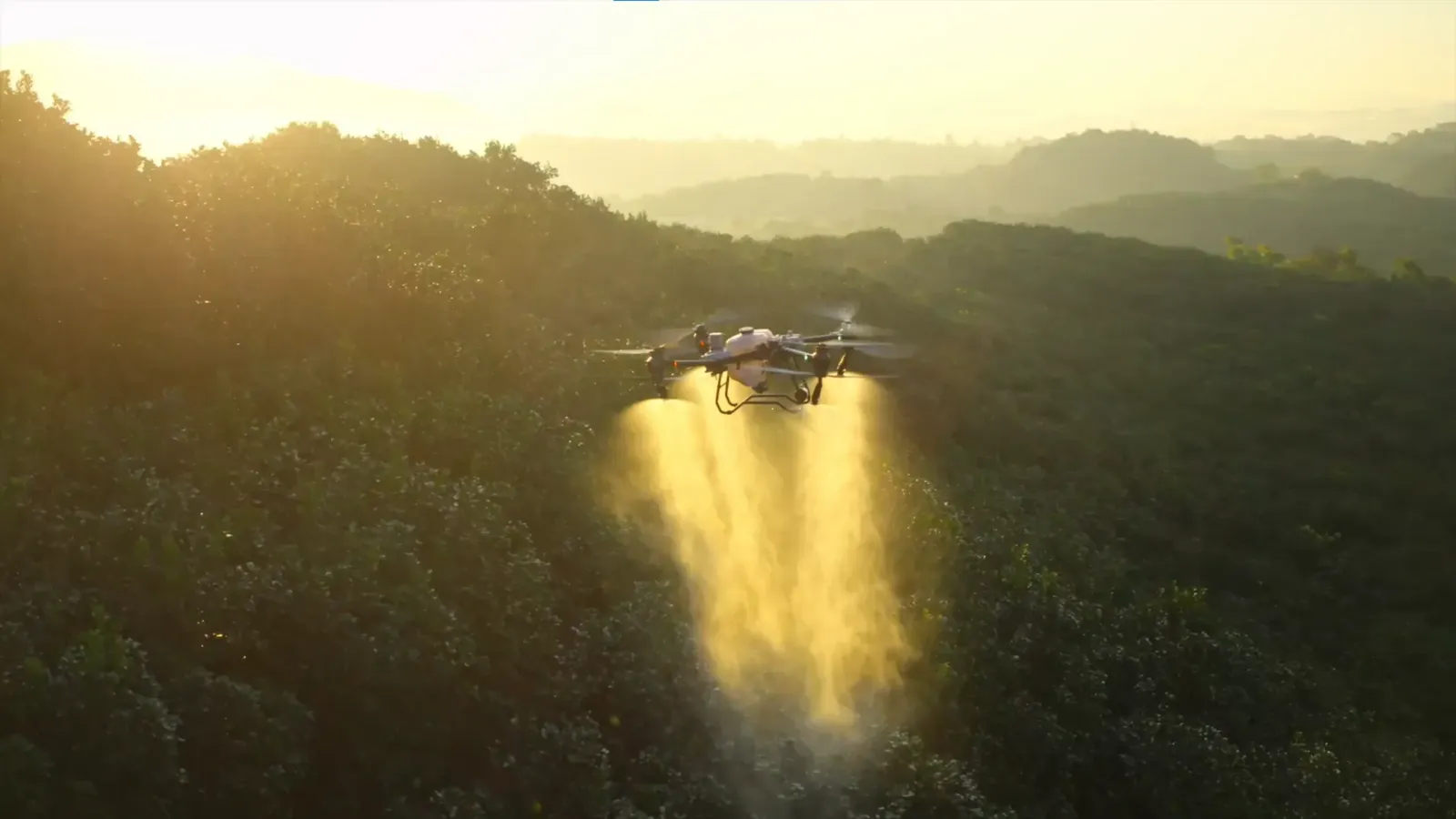
Cotton is a tall, densely planted crop that needs spraying several times a season. Tractor spraying damages rows, machinery cannot enter wet soil after irrigation, and the right timing can be missed. Drone spraying removes these problems.
What can a drone do in cotton?
- Pest control: against bollworm, aphids, spider mites and other pests.
- Defoliation: even application of defoliant across the whole field before harvest.
- Foliar feeding: timely application of micronutrients and growth regulators.
Why a drone?
- No crushed plants: no tractor in the rows, no losses in dense planting.
- Works after irrigation: machinery cannot enter wet soil, a drone can still fly.
- Even coverage on tall plants: autonomous RTK flight with ±10 cm accuracy.
- Speed: up to 21 hectares per hour; about 100 hectares a day with one drone.
Our equipment
DJI Agras T50: 40 L tank, 4–11 m spray width, up to 24 L/min flow. DJI Agras T70P: 70 L tank, 30 L/min flow (40 L/min with 4 nozzles). Both drones use radar and binocular vision to detect obstacles 50–60 m ahead.
How we work
- Request: field location, size and crop.
- Mission plan: boundaries and obstacles are mapped and the flight route is built.
- Flight: spraying with the product and rate set by your agronomist.
- Report: treated area and amount used.
The minimum area is 20 hectares. We work in the cotton districts of the Aran plain — Barda, Aghjabadi, Saatli, Sabirabad, Imishli, Beylagan, Bilasuvar, Salyan, Kurdamir and Zardab. Prices depend on area, crop and location.